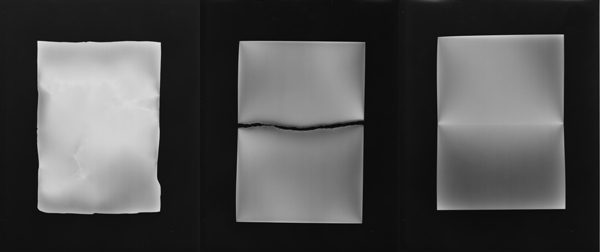
Light Concrete

Firefly, 4 minutes, 1.33, 2006

A boy and a girl expose a quantity of film to a constellation of fireflies, creating a cameraless portrait of bioluminescence. What the world looks like to a firefly, from birth to death.
An entomological etymology: it is because of “Luciferose” that fireflies glow. Fickle, flickery creatures, fireflies are best left to trace their own compositions in time and on the space of film directly, which, when unfurled, releases their pulses and dances in a jungle of illuminated film tendrils.


Tendril

direct exposure on color paper, 2006

Tendril describes the curl of unfurled film that lay on the color photo paper that I illuminated in the dark with a spark. The negatives are from a 35mm motion picture portrait of my curly-haired mother sitting on a shore.


Firefly light, direct exposure on color paper, 2006

When color photo paper is left out in the darkroom and fireflies prance about its surface, the bioluminescent traces they leave turn up in negative: purple spots on a white field as opposed to yellow spots on a black one. Fireflies are fickle and are best left to their own compositions. A concrete photograph.


Polaroid Self Portrait, 90 Polaroids, 2007

In this project, Polaroids are removed from their case in a darkroom, laid flat and exposed as a single, light sensitive array. After they are exposed, they are reinserted into the pack and –with the lens now covered- can be processed by simply pressing the camera's shutter and processing the film by ejecting it from the camera. By separating one-step photography into two irreducible steps of photochemical photography: exposure and chemical process, I disrupt the authority and authenticity inherent to Polaroid imaging. I am able to disorient an audience's preconceived understanding of how the world around them works.